


Blog
How a 320 g Mini Massage Gun Reaches 7,000 RPM — and What It Costs in Runtime and Noise

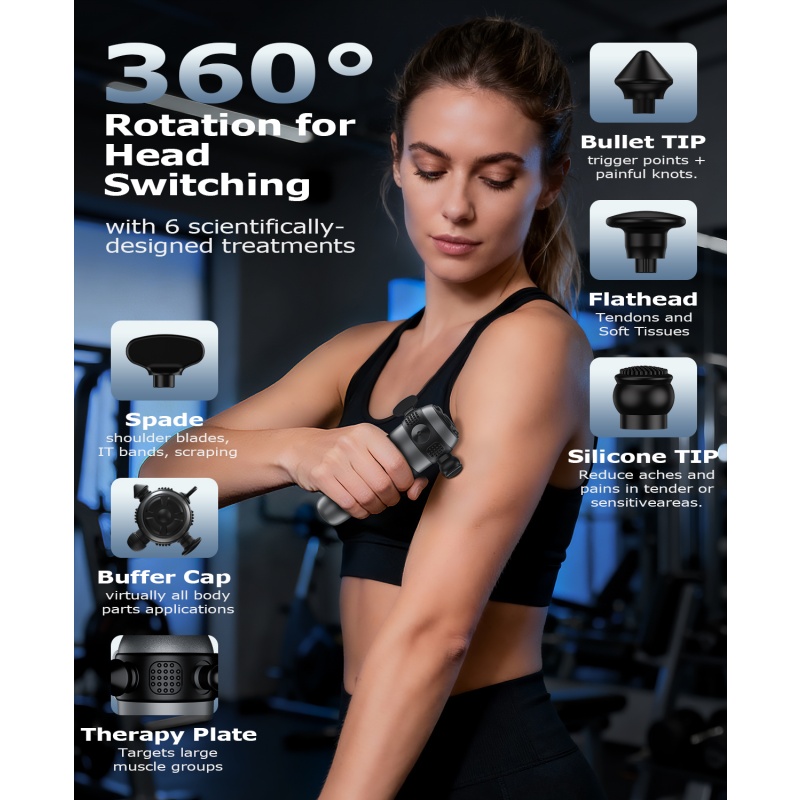
Most compact massage guns solve the weight problem by lowering the ceiling: 2,800 RPM, a 1,500 mAh cell, ten minutes of run time. The LD037 takes the other route — 320 g with a five-speed brushless motor rated 5,000–7,000 RPM — and the price for that is paid in two places buyers rarely see on a spec sheet: run time at the top setting, and noise. This article walks through the three design decisions that make the number possible, the arithmetic behind the battery claim, and the questions to put in an RFQ before you commit to a purchase order.
The 320 g Budget: Where Every Gram Goes
A percussion massage gun is four masses competing for one envelope: the motor and gearbox, the cell, the eccentric counterweight, and the housing that has to hold all of it in alignment. In a 1.1 kg full-size unit you can add mass to each without anyone noticing. At 320 g you cannot — a gram spent on battery structure is a gram not spent on the bearing seat.
| Component | What it does | What happens if you cut it |
|---|---|---|
| Brushless motor + gearbox | Converts electrical input into percussive motion | Speed sag under load, and sag again as the cell drains |
| 2,600 mAh / 7.4 V pack | 19.2 Wh of usable energy | Shorter run time, or a battery that heats up at 3 A draw |
| Eccentric weight + bearing seat | Generates stroke and amplitude | Weaker percussion, and a housing that buzzes instead of striking |
| Ribbed ABS housing | Holds bearing alignment under vibration | Resonance, rattle, and fatigue cracks at the motor boss |
At 7,000 RPM the eccentric weight completes 117 revolutions per second. Vibration force scales with the square of that speed, so the same 320 g body has to survive roughly four times the force it sees at 3,500 RPM. This is the real reason compact guns are usually slow: not the motor, but everything the motor shakes.
Motor Type: Why Brushed Units Sag and Brushless Ones Do Not
A brushed motor passes current through carbon brushes riding on a commutator. At 7.4 V and 22.2 W the LD037 draws about 3 A, and at 3 A those brushes produce both electrical loss and heat. In a sealed 15.8 × 8.6 × 8.6 cm housing that heat has nowhere to go, and the symptoms are predictable: the unit runs well for the first ten minutes, then loses authority near the end of the charge.
A brushless motor moves commutation to electronics, removes the brush interface, and keeps more of its input as shaft power. Two consequences matter to a brand owner. First, speed stays closer to the rated figure as the cell drains. Second, there is less heat soaking into the housing — which is also one of the reasons a 320 g unit can claim ≤ 55 dB rather than the 65–70 dB typical of cheap brushed mini guns.
Two questions separate a real rating from a marketing one. Ask for no-load and loaded RPM at each of the five settings, and ask what RPM the unit still holds at 20% battery. A supplier who cannot answer the second question has not tested their own product at the point where customers complain.
Balance Is What the User Feels, Not What the Spec Sheet Says
One gram of imbalance at 10 mm of eccentricity, spinning at 7,000 RPM, produces roughly 5.4 N of oscillating force. That is about half a kilogram of shake running at 117 Hz — enough to be felt as buzz in the palm, and enough to fatigue a housing joint over a few hundred hours. Balance is therefore a manufacturing tolerance, not a design feature: it depends on how consistently the eccentric weight is machined and how rigidly the bearing seat is located.
That is why the LD037 uses an impact-resistant ABS shell with a ribbed internal structure rather than a single moulding. The ribs are not there to survive drops, although they help; they are there to keep the bearing bore round while the motor is running, because a bore that flexes by a few hundredths of a millimetre turns a clean percussive stroke into noise.
A 60-second bench test tells you most of what you need to know: run the sample at speed 5 on a hard table and listen for rattle, then feel the housing around the motor boss for heat. A well-balanced unit is warm, not hot, and you hear the stroke rather than the shell.
Five Speeds Over 2,000 RPM: What 400 RPM Steps Buy You
Five digital levels across a 5,000–7,000 RPM span works out to roughly 400 RPM per step, or about 5.7% at the top end. That granularity is what makes a single device usable on a neck at level 1 and on the glutes at level 5 without the jump between settings feeling like a different tool.
More speeds is not automatically better. What matters is where the steps land relative to the amplitude: a six-speed unit with 500 RPM steps gives a coarser low end, which is exactly where sensitive areas need the finest control. When comparing samples, set both devices to their lowest setting and feel the difference in the hand — that is the setting a travel user actually lives on.
Run Time: Do the Arithmetic Before You Print the Box
Here is the calculation any buyer should run before accepting a battery claim. A 2,600 mAh pack at 7.4 V holds 19.2 Wh. At the rated 22.2 W that is about 52 minutes of continuous running at full draw. The published figure for the LD037 is 2 hours continuous — which means it is a mixed-use number: the gun spends most of its time at levels 1–3, where the current draw is a fraction of peak.
Neither number is wrong, but they answer different questions. A 10-minute session at level 3 fits comfortably inside the 2-hour figure, giving roughly twelve sessions per charge. A buyer who plans to run level 5 continuously for a 45-minute treatment should be told 52 minutes, not 2 hours.
Charging is the other half of the arithmetic. The pack charges over USB-C at 5 V / 2 A, which is 10 W, and a full charge takes about 4 hours. That is longer than the 1.9 hours the energy figure alone would suggest, because a lithium pack tapers to constant-voltage at the end and the charge circuit limits input. It also means a 65 W PD charger will not fill it faster: the BMS sets the ceiling, not the charger.
Practical RFQ wording: state run time at speed 1 and at speed 5 separately, and state charge time with the cable supplied in the box. That single sentence removes most of the post-launch returns caused by a runtime claim that was technically true and practically misleading.
Noise: A dB Figure Means Nothing Without a Distance
Sound pressure drops about 6 dB every time you double the distance from the source. A unit measured at 30 cm can therefore be quoted 6 dB quieter than the same unit measured at 1 m. When a spec sheet says ≤ 55 dB, the only useful follow-up is: at what distance, at which speed, and in what kind of room?
For reference, 55 dB(A) sits near a quiet office or a domestic refrigerator — quiet enough for an open-plan office, a hotel room, or a long-haul flight. The number is credible for this platform because the noise sources are controlled at the design stage: brushless commutation removes brush whine, ribbed housing suppresses shell resonance, and a balanced eccentric weight removes the 117 Hz thump that cheap units turn into rattle.
To compare samples fairly, ask each supplier for the same protocol: 1 m from the unit, free field, speed 5, A-weighted, three consecutive readings. Then measure the samples yourself the same way. The ranking that comes out of that test is usually different from the ranking on the spec sheets.
What This Means for Packaging and Carton Economics
A 320 g travel massage gun plus head, pouch and colour box lands at about 650 g per retail unit. Sixteen units per carton gives 10.40 kg gross, which stays under the 15 kg manual-handling threshold most warehouses and 3PLs plan around — one picker can move a full carton without a trolley, and the carton still fits standard pallet footprints without overhang.
For Amazon sellers the same carton is close to an ideal inbound unit: heavy enough to keep freight per unit down, light enough to avoid two-person handling rules in most fulfilment centres. The full packaging and carton-design discussion — box artwork, certification panels, dimensional weight — belongs in a separate article; the point here is that the weight budget set by the motor and cell also sets the carton economics.
The RFQ Checklist for a Compact Massage Gun
Copy these eight questions into your next enquiry and compare answers side by side:
- No-load and loaded RPM at each speed setting, plus the RPM the unit holds at 20% battery.
- Run time measured separately at speed 1 and speed 5, with the test method stated.
- Charge time with the supplied cable, and whether the BMS accepts higher-wattage chargers.
- Noise in dB(A) at 1 m, speed 5, with the measurement environment described.
- Eccentric weight mass and the balance tolerance in gram-millimetres.
- Housing material, wall thickness, and whether the bearing seat is metal or moulded.
- Certification documents for the exact configuration you are ordering — CE, RoHS, FCC, UL.
- Carton quantity, gross weight, and carton dimensions for the retail packaging you want.
FAQ
Is 7,000 RPM too strong for a mini massage gun?
It is too strong to use continuously on the neck or spine at level 5, which is why the five-speed range matters more than the peak figure. Most users spend their time at levels 1–3 and use level 5 for larger muscle groups such as the glutes and quads.
Can a 320 g unit really carry a 2,600 mAh cell and hold 7,000 RPM?
Yes, but not with a brushed motor or a single-moulding shell. The combination works because the motor is brushless and the housing is ribbed; both choices cost tooling money and save weight in operation. A supplier quoting the same numbers with a brushed motor and a plain shell is quoting the peak, not the sustained figure.
Why does my sample slow down near the end of the charge?
Voltage sag under load. As the pack drops toward its cut-off, the motor sees less voltage and loses speed. Brushless motors resist this better than brushed ones, and a controller with low-voltage compensation resists it better still — which is why the 20%-battery RPM question in the checklist above matters.
What is the minimum order for a custom colour or logo?
500 pcs per configuration, with colourways combinable within one order to reach that total. Logo and packaging changes do not trigger new certification testing because the electrical design is unchanged; housing or motor changes do.
Next Step
If you are sourcing a small massage gun for travel retail, corporate gifting or an Amazon listing, send your target market, quantity and branding requirements. We will come back with pricing, carton dimensions, a sample timeline, and the test data behind every number above.
Browse the mini massage gun range →
LD037 320 g mini massage gun — full specification →
Compare against the full-size massage gun range →
Certification documents (CE, RoHS, FCC, UL, ISO 9001) →
How our OEM and private-label process works →
One thought on “How a 320 g Mini Massage Gun Reaches 7,000 RPM — and What It Costs in Runtime and Noise”