


Mini Massage Gun
Mini Massage Gun Manufacturer - 320 g, USB-C, Factory Direct
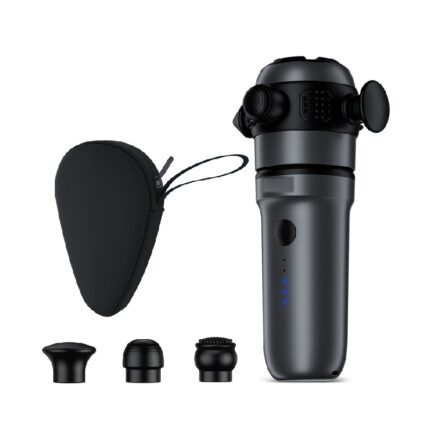
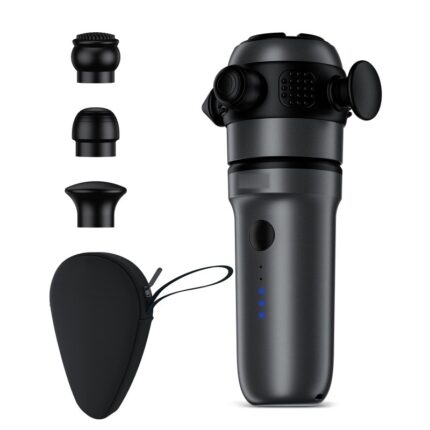
Shenzhen Jindouer manufactures the LD037 mini massage gun: 320 g with battery, five-speed brushless motor, 5,000-7,000 RPM, 2,600 mAh with USB-C charging, three heads and a travel pouch, CE / RoHS / FCC / UL. Supplied factory-direct to travel-gear brands, physio clinics buying patient kits and Amazon sellers. MOQ 500 pcs, 35 days.
Why the Mini Format Is the Fastest-Growing Segment
Full-size percussion guns solved a problem most people do not have. A 1.2 kg device is the right tool for a therapist working on a client, and the wrong tool for someone who wants twenty minutes on their own shoulders after a flight. The massage gun mini segment exists because the second person outnumbers the first by a wide margin, and because a 320 g unit fits in a carry-on where a full-size one does not.
That shift changes what a brand has to get right. In the full-size category the specification fight is stall force and amplitude. In the mini category it is weight, noise and whether the battery survives being charged from a laptop.
Travel Massage Gun: What Actually Breaks in Transit
A travel massage gun fails in three predictable ways, and none of them are the motor. First, the charging port: USB-C receptacles tear off the board when a cable is yanked at an angle, which is why ours is anchored to a reinforced bracket rather than surface-mounted. Second, the battery: a 2,600 mAh lithium pack has to carry UN38.3 documentation to fly, and brands that skip this discover it at the freight forwarder. Third, the head mount: a friction-fit head works loose after a hundred cycles in a bag.
We ship the LD037 with a travel pouch and a locking head mount specifically because these three are what come back as returns. If you are building a travel-focused range, ask any supplier for their UN38.3 file before you ask for their price.
Compact and Small Massage Gun Formats: Where the Weight Threshold Sits
The difference between a compact massage gun and a small massage gun is not marketing language, it is the 400 g line. Below 400 g a device can be held one-handed at full extension for a full session without the wrist dropping. Above it, users naturally switch to two hands and the product stops feeling like a personal device.
The LD037 sits at 320 g without sacrificing amplitude, which is the engineering problem in this format: shedding mass usually costs stroke length. We solve it with a shorter, stiffer spring and a lighter counterweight rather than a smaller motor, so rated RPM is unaffected.
Portable Massager and Handheld Massager: Specifying for Retail
Retail buyers sourcing a portable massager or a handheld massager are usually solving a shelf problem, not an engineering one. The device has to fit a defined box, survive a drop test from 1.2 m, and look like it costs more than it does. That means housing finish and packaging carry as much weight as the specification sheet.
We quote housing colour, retail box print and insert tooling together, because a brand that sources the device and the box separately almost always ends up with a unit that rattles in its own packaging. Both come off the same production schedule here.
Mini Massager Handheld: Packaging and Amazon FBA
A mini massager handheld programme sold through Amazon lives or dies on dimensional weight. A 320 g device in an oversized box can double its own shipping cost, and FBA fees are calculated on the box, not the product. We design retail packaging against the target FBA size tier rather than against a design mockup, and we will tell you when a box has to grow to protect the unit.
If you are preparing a listing, our notes on mini massage gun packaging for Amazon FBA cover the size-tier breakpoints and the insert design that keeps a 320 g unit from moving in transit.
Deep Tissue Mini: Where the Format Stops Working
A massagers handheld deep tissue mini specification is the one place we push back. Deep tissue work needs amplitude, and amplitude needs mass and stroke. A 320 g unit will reach the superficial layer of a quadriceps but not the deep fibres of a glute, and no amount of RPM marketing changes that.
Our recommendation for brands building a deep-tissue claim: use the mini format for recovery and travel positioning, and route deep-tissue buyers to the percussion massage gun range where the M3 Pro and LD203 carry the amplitude. A brand that overclaims on a mini device gets returns, not repeat orders.
RPM, Runtime and Noise: The Three Numbers Behind a Mini Claim
A mini device is judged on mini massager fundamentals: how many strokes per minute at the top setting, how long it holds them, and how loud it is at that setting. Ours holds 5,000-7,000 RPM across the discharge curve at 55 dB or lower, and the five speeds are tuned for tissue tolerance rather than for a specification headline.
For a brand, the useful question is not the peak number but the shape of the curve. A device that drops from 7,000 to 4,500 RPM after ten minutes reads as broken to a user even though the spec sheet says 7,000.
OEM and Sampling
Logo, housing colour and retail box are customised from 500 pcs per model, 35 days production. Samples ship from stock so a brand can test the platform before committing to packaging tooling. Full customisation scope sits on our OEM/ODM page, and the wider handheld range is on the LD037 product page. Send your target weight, box size and market to Carol@jindouer.com and we will come back with a platform recommendation and a costed BOM.